What a CDN Actually Does
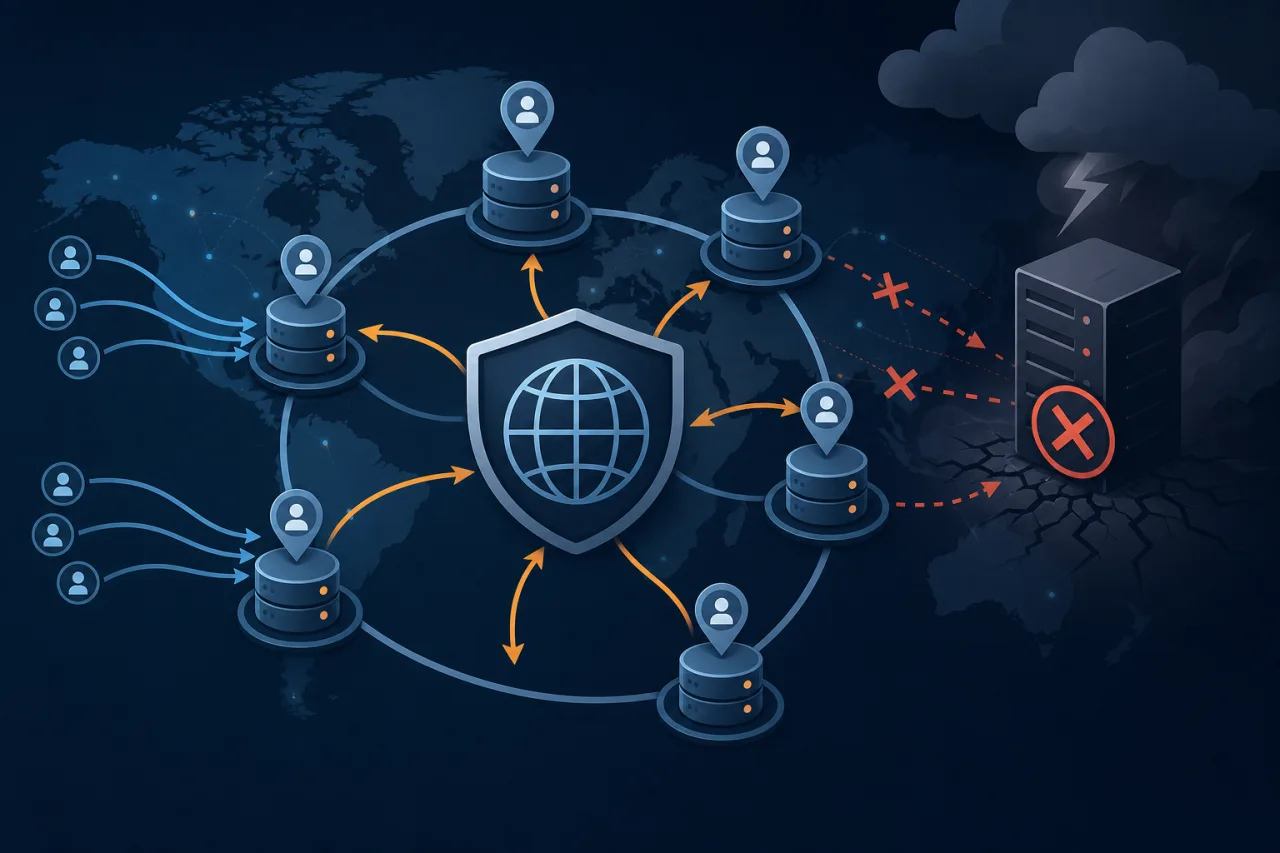
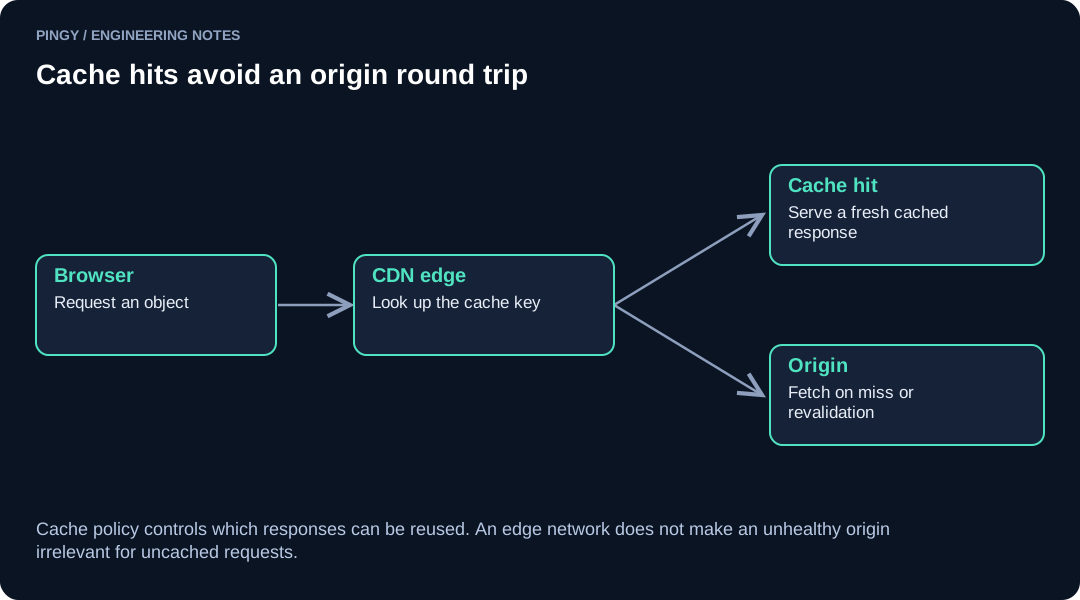
A CDN is a geographically distributed network of edge servers that cache and serve content closer to end users. When a request hits a CDN edge node, the node either serves a cached response directly or fetches it from your origin server—whichever is appropriate for that content type and cache policy.
The practical effect: your origin server handles a fraction of the raw request volume, and users get responses from a data center that may be hundreds of milliseconds closer to them.
How CDNs Contribute to Uptime
Origin shielding
Most CDNs funnel all cache-miss requests through a single "shield" or "mid-tier" node before they reach your origin. Instead of every edge PoP independently hammering your origin on a cache miss, only one upstream node does. This collapses the thundering-herd problem during traffic spikes and after cache purges.
Failover and redundancy
Modern CDNs support origin failover: if your primary origin returns 5xx errors or times out, the CDN can automatically route requests to a secondary origin or serve stale cached content. This is configured at the CDN level, not in your application, and can mean the difference between a visible outage and a transparent blip.
Common failover options available on most major CDNs:
- Primary/secondary origin groups — fail over to a backup origin on health-check failure
- Stale-while-revalidate / stale-if-error — continue serving cached content for a configurable window even if the origin is unreachable
- Anycast routing — DNS-level traffic distribution that automatically avoids unhealthy PoPs
DDoS and traffic spike absorption
A CDN's aggregate network capacity is typically measured in terabits per second across all PoPs. A volumetric attack or a sudden viral traffic event that would saturate a single-region origin is spread across dozens of edge locations. The CDN absorbs the volume; your origin sees only legitimate cache-miss traffic.
This is not magic—cache hit rate matters enormously. If your site is highly dynamic and cache hit rates are low, a spike will still reach your origin at scale. Audit your Cache-Control headers and identify which endpoints can tolerate caching even for short TTLs (30–60 seconds can dramatically reduce origin load).
Configuring Your CDN for Reliability
Here are the steps worth taking before you rely on a CDN for uptime:
- Set explicit
Cache-Controlheaders on all responses. Do not rely on CDN defaults; they vary by provider and are often conservative. - Enable origin health checks within the CDN control plane so failover is automatic, not manual.
- Configure a fallback origin in a different cloud region or provider. A CDN in front of a single-AZ origin is still a single point of failure at the infrastructure layer.
- Test stale-if-error behavior deliberately—take your origin offline in staging and confirm the CDN serves cached content rather than propagating errors to users.
- Review your TTLs for API responses. Even short TTLs (10–30 s) on read-heavy endpoints reduce origin pressure substantially during spikes without breaking freshness requirements.
- Enable HTTPS at the edge and terminate TLS there. This offloads handshake overhead from your origin and lets the CDN handle certificate renewal.
What CDNs Don't Solve
A CDN does not fix a slow or fragile origin. If your database query takes four seconds, that latency shows up on every cache miss. It also does not protect you from application-layer logic errors—a deploy that breaks your /api/health endpoint will still fail, CDN or not.
CDNs also introduce their own failure modes: misconfigured cache rules can serve stale or incorrect content, and some CDNs have had their own regional outages. Treating the CDN itself as infallible is a mistake.
Monitoring Through the CDN Layer
Because a CDN can serve cached responses even when your origin is down, synthetic monitoring that only pings your CDN-fronted URL may report "up" while your origin is actually broken. This creates a false sense of health.
Running uptime checks from multiple geographic regions—both against your CDN hostname and directly against your origin—gives you a complete picture. If your CDN-fronted URL is up but your origin health endpoint is returning 503s, you want to know before your cache TTLs expire and errors start propagating to users. Tools like Pingy monitor from multiple regions, which also helps distinguish a real outage from a localized routing problem.
Key Takeaways
- CDNs improve uptime by absorbing traffic volume, enabling origin failover, and serving stale content during origin outages.
- Cache hit rate determines how much protection you actually get—tune your
Cache-Controlheaders deliberately. - Configure origin health checks and a secondary origin so CDN failover is automatic.
- A CDN in front of a single-region origin still has a single point of failure; diversify your origin infrastructure too.
- Monitor both your CDN-fronted hostname and your origin directly to catch failures the CDN is masking.
- Test your failover and stale-content behavior before you need it in production.