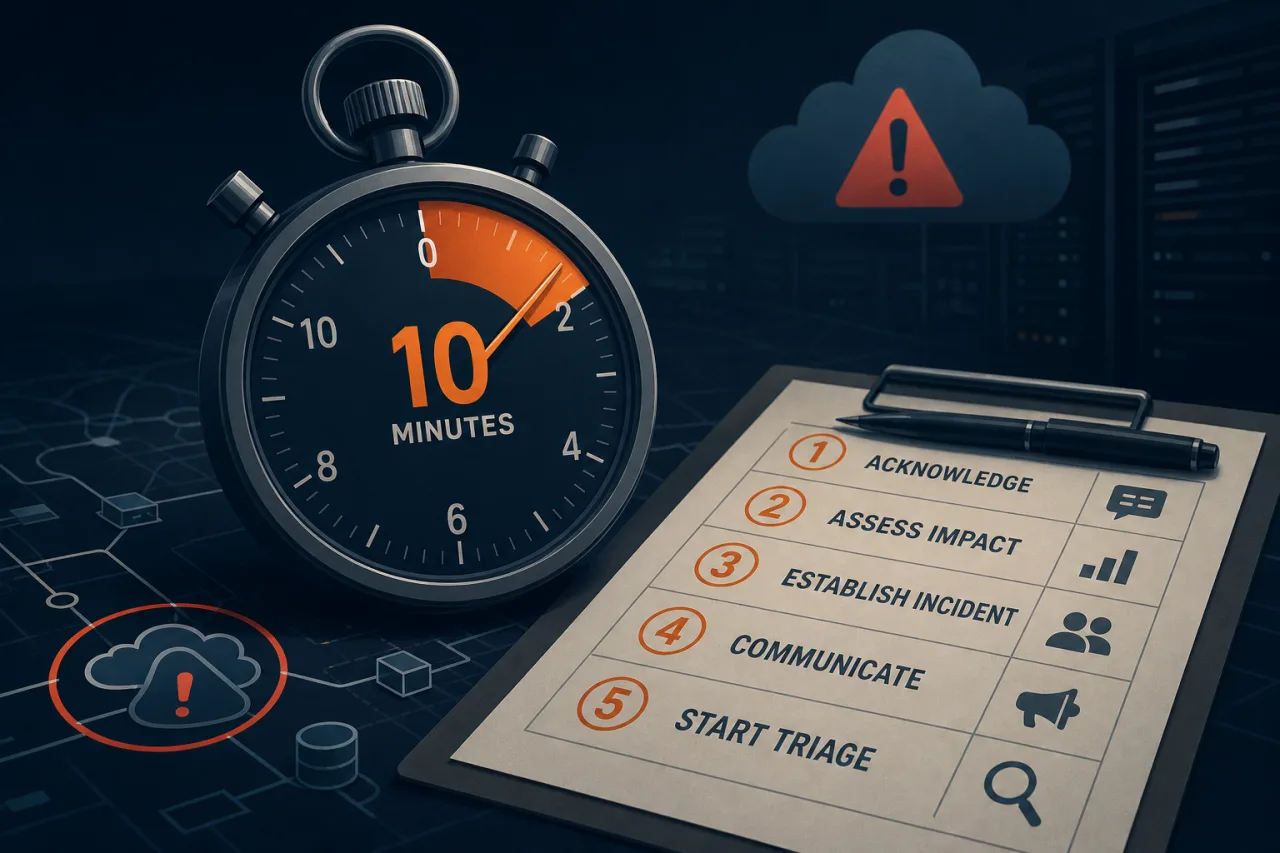
Why the First 10 Minutes Matter
The opening minutes of an outage set the trajectory for everything that follows. Slow coordination, duplicate work, and missed communication don't just extend downtime — they make the post-mortem harder and erode team trust. Having a practiced checklist turns a chaotic fire drill into a structured response.
This isn't about heroics. It's about muscle memory.
Minute 0–2: Confirm the Incident Is Real
Before you mobilize anyone, verify you're looking at an actual outage and not a flaky alert or a monitoring misconfiguration.
Quick verification steps:
- Check your monitoring dashboard for alert source and affected regions
- Confirm the alert is firing from at least two independent check locations — a single-region monitor false-positive is common
- Attempt a manual curl or synthetic check from your own machine
- Look for a corroborating signal: error rate spike, latency jump, support tickets, or a teammate's Slack message
Multi-region uptime monitoring (like what Pingy runs) is useful here precisely because it distinguishes a real outage from a probe-location network blip. If checks from Frankfurt, Singapore, and Virginia all agree — it's real.
Once confirmed, the clock starts. Declare the incident.
Minute 2–4: Declare and Assign Roles
Ambiguity kills response speed. The first person to declare is usually the incident commander (IC) by default — formalize it immediately.
Minimum roles to assign:
- Incident Commander (IC): Owns the incident timeline, coordinates responders, makes calls
- Technical Lead: Digs into logs, metrics, and code — does not multitask with communication
- Comms Lead: Handles internal updates and customer-facing status page posts
For smaller teams, one person can hold IC + Comms, but the Technical Lead should stay heads-down. Interrupting them for status updates costs more than it saves.
Open a dedicated incident channel (e.g., #inc-2024-07-12-api-down) immediately. All incident communication goes there. No sidebars.
Minute 4–7: Establish Scope and Impact
You need to answer three questions before you can triage effectively:
- What is broken? — API, database, CDN, a specific endpoint, a single dependency?
- Who is affected? — All users, a subset (by region, plan tier, or feature), internal tooling only?
- Is it getting worse? — Stable error rate, or climbing?
Pull your key signals in parallel:
- APM traces for error clustering (service, endpoint, host)
- Infrastructure metrics: CPU, memory, connection pool saturation, disk I/O
- Deployment and config change log — what changed in the last 2 hours?
- Dependency health: third-party APIs, managed databases, CDN status pages
The Recent Change Rule
If something changed in the last two hours — a deploy, a feature flag flip, a config push, a cron job — treat it as the prime suspect until eliminated. Most production outages have a proximate cause that correlates with a recent change.
Minute 7–10: Act or Escalate
By now you have enough information to do one of three things:
Option A — Rollback or revert. If a recent deploy correlates with the incident start time and symptoms match, roll back. Don't wait for root cause confirmation. Restore service first, investigate second.
Option B — Isolate and mitigate. If rollback isn't viable, consider: Can you disable the broken feature? Route traffic away from the failing host? Scale up to absorb load? A partial mitigation that reduces customer impact buys time for a proper fix.
Option C — Escalate. If the cause is unclear or the fix requires someone not in the room (a DBA, a network engineer, a vendor), escalate now. Every minute spent spinning without the right expertise is waste.
Post every decision to the incident channel with a timestamp. Even a one-line note — 07:43 UTC — rolling back v1.4.2, ETA 3 min — keeps the whole team oriented and feeds your timeline for the post-mortem.
A Note on Customer Communication
If the outage is customer-facing, post a status page update before you have answers. "We are investigating reports of elevated errors affecting the API. More updates in 15 minutes." Silence is always worse than an honest "we're looking into it."
Key Takeaways
- Verify before mobilizing — confirm with multi-location checks, not a single alert
- Declare fast and assign roles explicitly; ambiguity wastes minutes
- Scope the impact before diving into fix mode
- Treat recent changes as the prime suspect by default
- Restore service first, find root cause second
- Log every decision with a timestamp as you go
- Communicate to customers early, even without answers