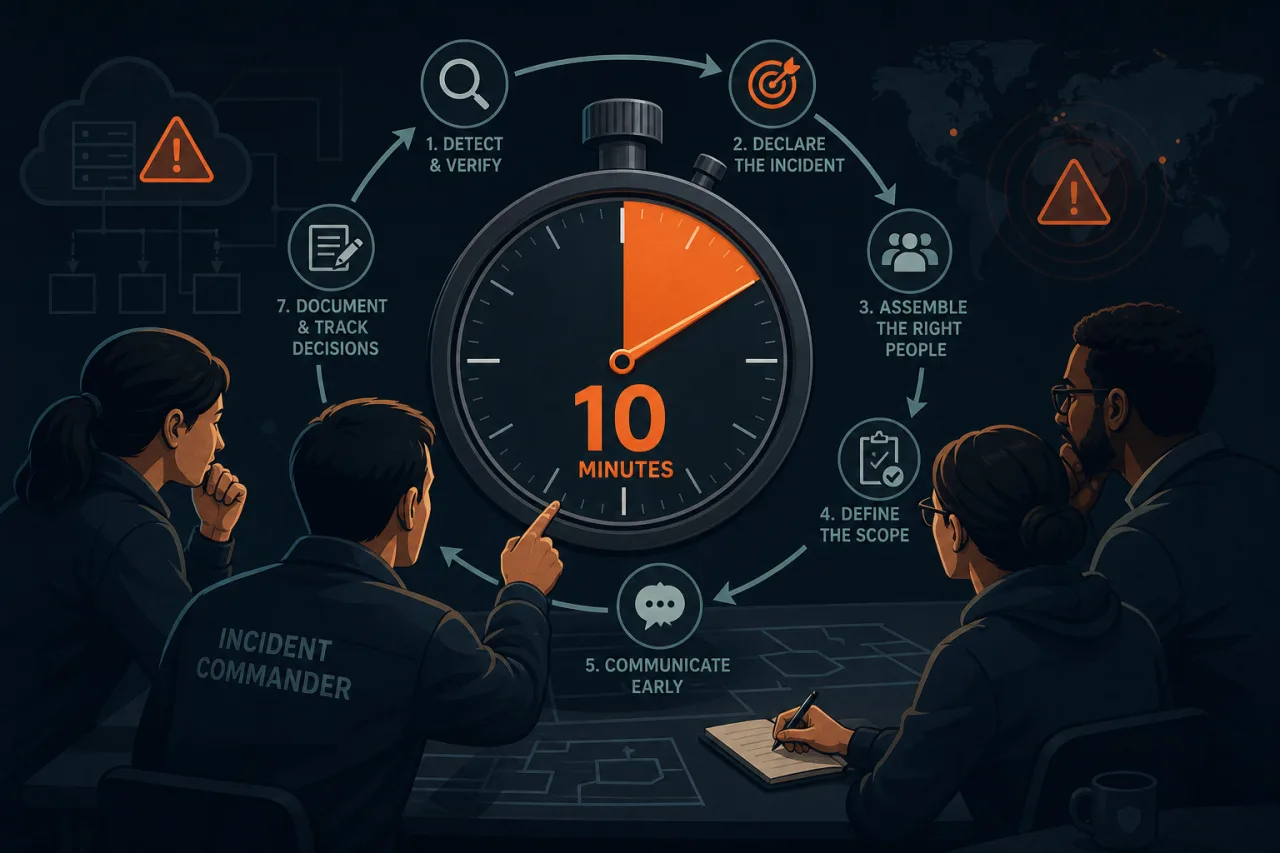
Why the First 10 Minutes Matter
The opening minutes of an incident set the trajectory for everything that follows. Decisions made — or avoided — in this window determine how fast you restore service, how much data you collect for a post-mortem, and whether a small fire becomes a five-alarm crisis.
This checklist is written for whoever is holding the incident commander (IC) role, whether that's a dedicated on-call engineer or a senior dev who just got paged at 2 a.m.
Minute 0–2: Confirm the Incident Is Real
Before you wake anyone up, verify the signal.
- Check your monitoring source. Is the alert from a single probe location or multiple? A single-region alert can indicate a network blip local to that probe. Alerts confirmed from multiple geographically distributed check locations are far more likely to represent a real user-facing outage.
- Hit the service yourself. Open the site or call the API endpoint directly. Does it fail the same way the alert describes?
- Check your status page and recent deploys. Was anything pushed in the last 30 minutes? A failed deployment is the most common cause of a sudden degradation.
If you can't confirm the incident within two minutes, declare it anyway and continue investigating. False positives are cheaper than delayed responses.
Minute 2–5: Declare and Communicate
Once you've confirmed something is wrong, declare the incident formally. This is not bureaucracy — it starts the clock, creates a shared record, and gives your team permission to drop other work.
Steps
- Open an incident channel. Create a dedicated Slack channel (e.g.,
#inc-2024-08-12-api-down) or use your incident management tool. Do this before you start debugging. - Post an initial summary. One or two sentences: what is broken, what is the user impact, when it started. Don't speculate on cause yet.
- Assign roles. At minimum: an IC (you), a communications lead if customer-facing, and a scribe to log everything in the channel.
- Page the right people. Escalate based on the affected system — not based on who you know is awake. Paging the wrong team costs 10–15 minutes you don't have.
- Update the status page. Even a vague "We are investigating reports of degraded service" is better than silence. Users and customer-facing teams need something.
Minute 5–8: Orient, Don't Diagnose
This is the most common mistake: the IC disappears into a terminal and starts debugging alone. Your job is coordination, not root cause analysis.
Orient the room
- Define the blast radius. What percentage of users or requests are affected? Is it all regions, one data center, one customer tier?
- State what you know and what you don't. "API latency is up 10x. Database looks healthy. We don't yet know if it's the load balancer or the app tier."
- Assign investigation tracks. Send one engineer to check infrastructure metrics, another to review app logs. Parallel investigation beats sequential.
- Set a sync cadence. "I want a 60-second update from each track in three minutes."
Avoid the temptation to form a hypothesis and only look for confirming evidence. Keep tracks independent until data converges.
Minute 8–10: Decide on Immediate Mitigations
By now you should have enough signal to consider fast mitigations — actions that restore service without necessarily fixing the root cause.
- Rollback the last deploy if there's any correlation between the push and the incident start time.
- Shift traffic away from a degraded region or instance if your infrastructure supports it.
- Disable a feature flag if the degradation is isolated to a new feature.
- Increase capacity if the symptom is resource exhaustion and you have headroom to scale.
Mitigations are not fixes. Make this explicit to your team. You're buying time for a proper diagnosis, not closing the incident.
A Note on Monitoring as Your First Signal
The quality of your initial data shapes every decision above. Monitoring that checks from a single location can leave you guessing whether an alert is real. Multi-region checks — where a tool like Pingy confirms a failure from multiple independent vantage points before alerting — reduce the noise and give you geographic context immediately. Knowing that your service is unreachable from both US-East and EU-West is actionable in a way that a single-probe alert is not.
Key Takeaways
- Confirm the incident is real before escalating, but don't let verification delay declaration past two minutes.
- Declare early and formally — it creates the shared context your team needs.
- The IC's job is coordination, not debugging. Assign investigation to others.
- Pursue parallel investigation tracks to avoid tunnel vision.
- Prefer fast mitigations (rollback, traffic shift, flag disable) over waiting for root cause.
- Multi-region monitoring gives you geographic blast radius context from the first alert.