The Problem With Checking From One Place
Most developers set up uptime monitoring and never think about where the check is running from. You pick a tool, paste in your URL, set a 1-minute interval, and call it done. But that check is running from a single server in a single data center — and that creates a blind spot you probably haven't considered.
If your monitoring node loses internet connectivity, your site gets flagged as down when it isn't. If your CDN has a regional outage, users in Europe may be hitting errors while your single US-based monitor reports everything green. Both failure modes erode trust in your alerts — one causes false alarms, the other causes missed incidents.
What Single-Location Checks Miss
Here's a non-exhaustive list of real failure scenarios that a single monitoring location will either misreport or miss entirely:
- Regional CDN or DNS failures. A CDN edge node failing in Asia-Pacific won't necessarily affect a monitor in Virginia.
- BGP routing incidents. A route leak or blackhole can make your site unreachable from specific ASNs or geographies while the origin server is healthy.
- Geoblocking misconfiguration. A firewall rule accidentally blocks a subnet — the single monitor happens to be on a different subnet and keeps passing.
- Data-residency-driven latency spikes. Users in the EU get slow responses because traffic is routing through the wrong region; your single US monitor sees normal latency.
- Flapping network paths. Intermittent packet loss on a specific network path causes partial outages that a single poller might catch some of the time but not consistently.
None of these show up cleanly with one vantage point.
How Multi-Region Monitoring Works
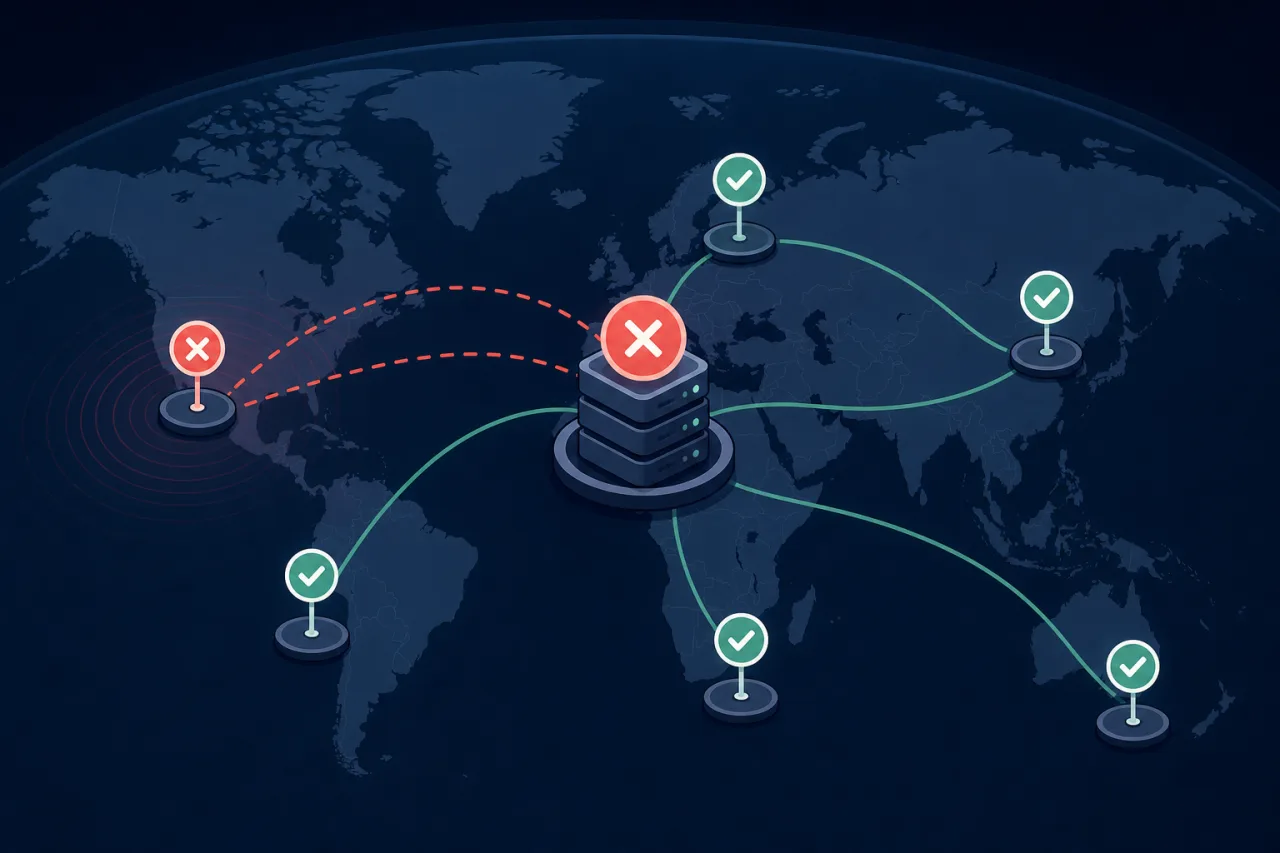
Multi-region monitoring runs the same check simultaneously from several geographically distributed locations — typically spanning different continents, different ISPs, and different cloud providers. The monitoring service then aggregates the results before deciding whether to fire an alert.
A common alerting strategy is majority voting: if 3 out of 5 locations report a failure, the incident is confirmed and the alert fires. This approach filters out transient failures local to one node without hiding real outages that affect most of the world.
Choosing a Confirmation Threshold
The right threshold depends on your risk tolerance:
- Alert on any single failure — maximum sensitivity, higher false-positive rate. Good for internal health checks where you want early warning.
- Alert when 2+ locations fail — balances sensitivity with noise reduction. Works well for most production services.
- Alert when a majority fail — conservative. Reduces noise significantly but may delay notification for genuinely regional outages.
For most external-facing services, alerting when 2 or more independent locations confirm a failure is a reasonable default.
Diagnosing Regional vs. Global Outages
Beyond reducing false positives, multi-region data helps you triage faster. When an incident fires, you can immediately answer:
- Is this affecting all regions or just one?
- Which geography is impacted?
- Is it consistently failing or intermittent?
If only your Tokyo and Singapore nodes are failing, you're looking at an Asia-Pacific issue — probably CDN, DNS, or a regional cloud provider problem. If all nodes fail at once, the issue is likely at your origin. That distinction alone can cut your mean time to diagnosis significantly.
Services like Pingy run checks from multiple locations and surface per-region status in the incident timeline, which makes this triage step straightforward without requiring you to manually spin up VMs in different clouds.
What to Look for in a Multi-Region Setup
If you're evaluating monitoring tools or auditing your current setup, check for:
- Location diversity — nodes should span different continents, not just different AWS regions in the same geography
- ISP diversity — checks from a single cloud provider's backbone will share failure modes; independent ISPs give cleaner signal
- Transparent node locations — you should know exactly where checks run from, not just "globally distributed"
- Per-location results in alerts — incident notifications should tell you which locations failed, not just that a failure occurred
- Configurable confirmation logic — you should be able to tune how many failures trigger an alert
Key Takeaways
- A single monitoring location produces both false positives (monitor goes offline) and false negatives (regional outages the monitor doesn't see).
- Multi-region checks give you a much more accurate picture of what real users in different parts of the world are experiencing.
- Majority-voting confirmation logic cuts alert noise without hiding genuine incidents.
- Per-region failure data makes triage faster — you can tell a regional CDN issue from an origin failure in seconds.
- When evaluating monitoring tools, prioritize ISP and continent diversity over raw number of locations.