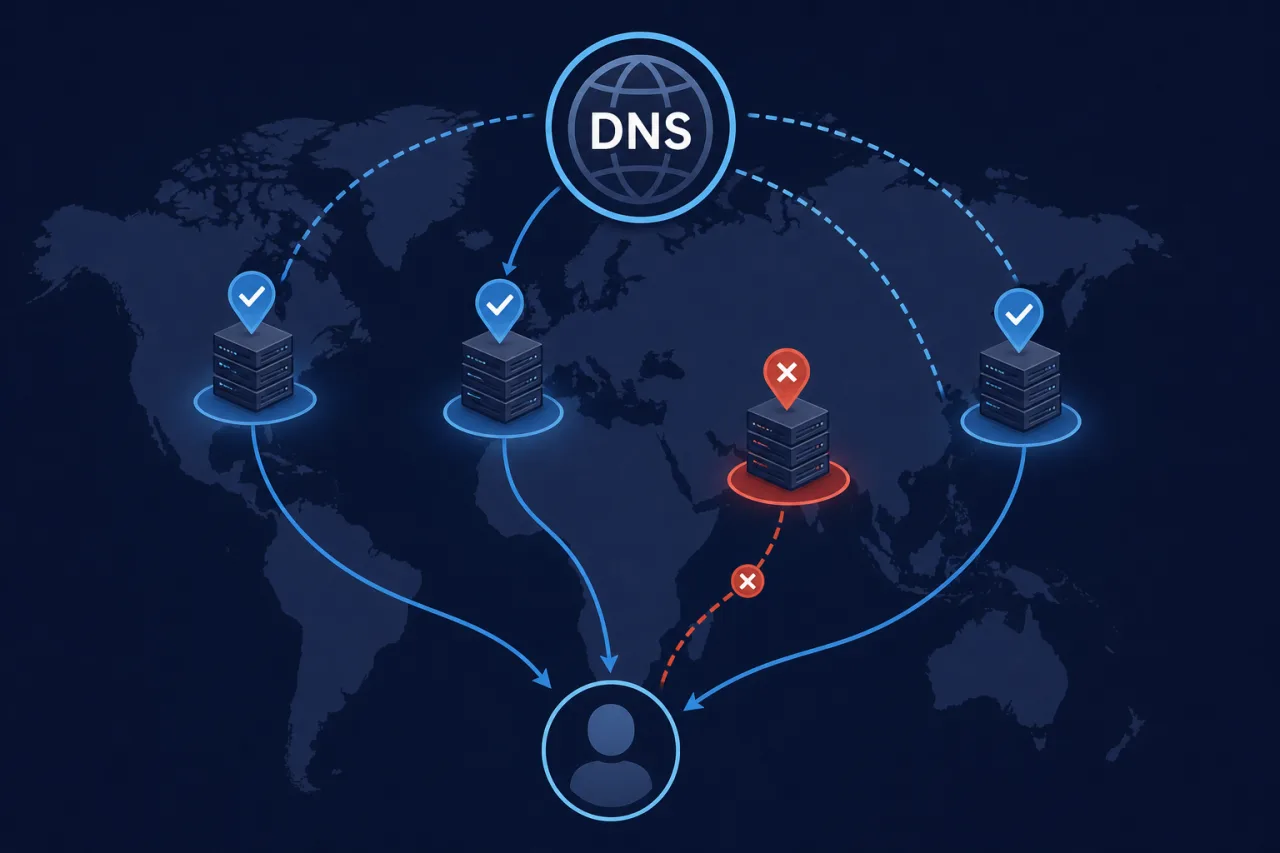
What Problem Are We Actually Solving?
A single load balancer in one data center is a single point of failure with a fixed geographic penalty. A user in Singapore hitting your origin in Virginia adds 200 ms of round-trip latency before your application does anything. Global Server Load Balancing (GSLB) and anycast DNS are two complementary tools that solve both problems.
They are often confused with each other. They are not the same thing.
GSLB: DNS-Based Traffic Steering
GSLB is a traffic management strategy that uses DNS responses to direct clients to the best available endpoint — where "best" can mean closest, healthiest, least loaded, or some combination of all three.
When a client resolves api.example.com, a GSLB-aware DNS server (often called an authoritative DNS with health-awareness) returns the IP of the most appropriate origin, not just any origin.
How a GSLB decision gets made
A GSLB system typically evaluates:
- Geographic proximity — based on the resolver's IP, estimated via GeoIP databases
- Health checks — active probes to each origin; unhealthy endpoints are removed from the answer set
- Load or latency signals — some systems ingest RTT data or server-reported load metrics
- Failover policy — primary/secondary rules for when a region goes dark
The DNS response carries the winning IP, and the TTL you set controls how quickly clients re-resolve after a change. Keep TTLs low (30–60 seconds) on GSLB records if you need fast failover. Understand the trade-off: low TTLs increase resolver query volume.
GSLB is not instant failover
Because DNS is cached at multiple layers — the client OS, the stub resolver, the recursive resolver — even a 30-second TTL does not mean all clients switch in 30 seconds. Plan your failover SLAs around minutes, not seconds.
Anycast DNS: One IP, Many Locations
Anycast is a network routing technique where the same IP address is announced from multiple physical locations via BGP. Routers direct each packet to the topologically nearest node announcing that prefix.
Most large public DNS resolvers (1.1.1.1, 8.8.8.8) use anycast. Your authoritative DNS servers can too.
What anycast buys you
- Latency reduction — DNS resolution itself is faster because the authoritative server is geographically closer to the resolver
- DDoS resilience — volumetric attacks are absorbed across many PoPs rather than concentrated at one IP
- Transparent failover at the routing layer — if a PoP goes offline, BGP withdraws the route and traffic shifts to the next-nearest node automatically, without a DNS change
What anycast does not do
Anycast routes DNS queries to the nearest nameserver. It does not route your application traffic unless you also anycast your application IPs. These are separate decisions.
Combining GSLB and Anycast
A production architecture often layers both:
- Anycast your authoritative DNS so that the query itself resolves with minimal latency from anywhere on the internet.
- Run GSLB logic at those authoritative servers to return health-aware, geo-steered A/AAAA records.
- Anycast your application IPs (optional) at each regional PoP for the actual data plane if you want BGP-level failover there too.
Services like Cloudflare, NS1, AWS Route 53, and Azure Traffic Manager implement some or all of this. If you're building your own stack, you'll need anycast BGP sessions at each PoP and a health-check daemon that withdraws prefixes or flips DNS records on failure.
Health Checking: The Part That Actually Matters
GSLB is only as good as its health data. A GSLB system that doesn't know an origin is down will keep sending traffic into a black hole.
What to check
- HTTP/HTTPS endpoint returning 2xx (not just TCP open)
- Response time thresholds, not just reachability
- Synthetic checks that exercise a critical path (login, API key validation)
- Checks from multiple vantage points — a single-region health poller can miss regional outages
This is where multi-region uptime monitoring matters operationally. If your health checks run from one location and your GSLB serves six regions, you can have a regional outage that your poller never sees. Running checks from geographically distributed nodes — the same approach Pingy uses — gives you health signal that actually reflects what users in each region experience.
Checklist Before You Go Live
- TTLs on GSLB records set to 30–60 seconds
- Health checks probe application layer (HTTP 200), not just ping
- Checks run from at least three geographically distinct locations
- Failover tested by taking an origin offline in staging
- BGP route withdrawal tested if using anycast on the data plane
- Monitoring alerts fire before GSLB finishes failing over
- Runbook documents manual override procedure
Key Takeaways
- GSLB steers DNS responses based on health and geography; anycast routes packets to the nearest node announcing a shared IP.
- Low DNS TTLs improve failover speed but increase query volume — pick a number you can justify.
- Anycast at the DNS layer reduces resolution latency and absorbs DDoS; it is independent of anycast at the application layer.
- Health checks must probe the application, not just the network, and must run from multiple regions to be trustworthy.
- BGP-level failover (anycast) is faster than DNS-level failover (GSLB); use both where the architecture justifies it.