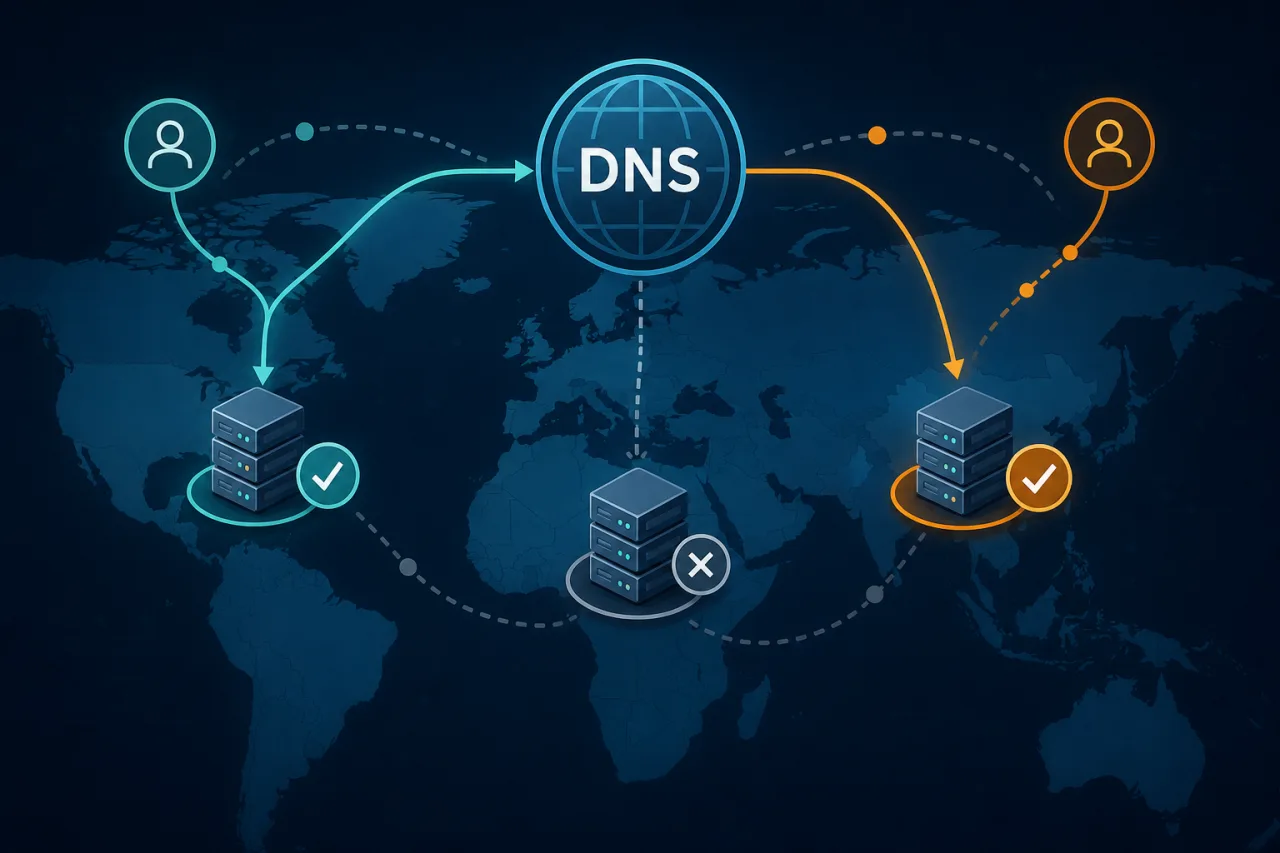
The Problem: One IP, Many Continents
When your service grows beyond a single data center, you face a routing problem. A user in Singapore hitting an origin in Frankfurt experiences real latency — often 200–300 ms round-trip — before a single byte of your application logic runs. Global Server Load Balancing (GSLB) and anycast DNS are the two main tools for solving this.
They solve similar problems but work very differently. Mixing them up leads to misconfigured infrastructure.
What Is GSLB?
GSLB is a DNS-based load balancing strategy that returns different IP addresses to DNS queries depending on logic evaluated at query time. The "global" part means the decision happens across multiple geographic regions or data centers.
A GSLB controller — whether a dedicated appliance, a cloud product like AWS Route 53, or an open-source solution like PowerDNS with a custom backend — responds to DNS queries with the address of the "best" server according to rules you define.
Common GSLB Routing Policies
- Geolocation / geoproximity — return the IP of the nearest PoP based on the resolver's location
- Latency-based — return the IP with the lowest measured RTT to the requesting region
- Weighted round-robin — split traffic by percentage across origins (useful for canary deployments)
- Failover — return a primary record; fall back to secondary if health checks fail
- Health-aware routing — combine any of the above, but exclude unhealthy origins from the answer set
Health-aware routing is the critical differentiator between GSLB and simple GeoDNS. GSLB continuously probes your origins; if a region goes down, it stops advertising that region's IP.
What Is Anycast DNS?
Anycast is a network-layer technique. Multiple machines in different locations announce the same IP prefix into BGP. Routers naturally deliver traffic to whichever announcement is topologically closest.
The most visible use is the DNS root servers — each "root server" is actually dozens of machines worldwide sharing a single IP via anycast. Cloudflare's 1.1.1.1 and Google's 8.8.8.8 work the same way.
You can run your own anycast infrastructure if you have:
- A BGP-capable provider or colocation in multiple regions
- An ASN and a portable IP block (a
/24or larger for IPv4) - Software like BIRD or FRR to manage BGP sessions
- The same application stack running identically at each site
Anycast gives you automatic failover at the network level: if a node stops announcing the prefix, traffic shifts to the next-closest node within BGP convergence time (seconds to a few minutes depending on your provider).
Anycast Limitations Worth Knowing
- TCP stateful flows can break if a failover event mid-connection routes packets to a different node with no session state
- BGP convergence is not instant — it is not a substitute for sub-second application-layer failover
- Debugging is harder —
tracerouteto the same IP from two locations may follow completely different paths - You do not control which PoP a specific user hits; you influence it only indirectly through BGP communities and route advertisements
GSLB vs. Anycast: Which to Use?
| GSLB | Anycast | |
|---|---|---|
| Works at | DNS layer | Network (BGP) layer |
| Failover speed | Bounded by DNS TTL | BGP convergence (seconds–minutes) |
| Requires your own ASN? | No | Yes |
| Health-check aware? | Yes, natively | Only if you withdraw routes on failure |
| Sticky sessions possible? | With low TTL + IP affinity | No |
For most product teams, GSLB is the pragmatic starting point. You get geo-routing and health-aware failover without needing an ASN or colocation agreements. Anycast becomes worth it when you are operating DNS infrastructure itself, or when you need routing decisions to happen below the DNS layer.
Health Checks: The Part People Get Wrong
GSLB is only as reliable as its health checks. A common mistake is checking a TCP port rather than an actual HTTP endpoint — the port can be open while the application is returning 500s.
A few concrete rules:
- Check from multiple vantage points. A health check from a single location can miss regional network partitions. If your GSLB controller is in us-east-1, it may see your eu-west-1 origin as healthy even when European users cannot reach it.
- Use meaningful endpoints. Hit a
/healthzroute that exercises a DB connection or cache ping, not just a static file. - Set TTLs deliberately. A 300-second TTL means up to 5 minutes of stale DNS after a failover. For critical paths, 30–60 seconds is more appropriate, accepting the increased query volume.
This is one place where external multi-region monitoring (Pingy checks from multiple locations simultaneously) gives you an independent view of origin health that complements what your GSLB controller sees.
Key Takeaways
- GSLB routes DNS responses based on health and geography; anycast routes packets via BGP — they are complementary, not interchangeable.
- Health-aware failover requires health checks that actually reflect application state, not just TCP reachability.
- DNS TTL is a ceiling on your failover speed under GSLB — set it based on your acceptable recovery time.
- Anycast requires operational investment (ASN, BGP, portable IP block) but provides sub-application-layer routing with no DNS dependency.
- Validate your GSLB health checks from outside your own network; a regional partition that your controller cannot see will still affect your users.