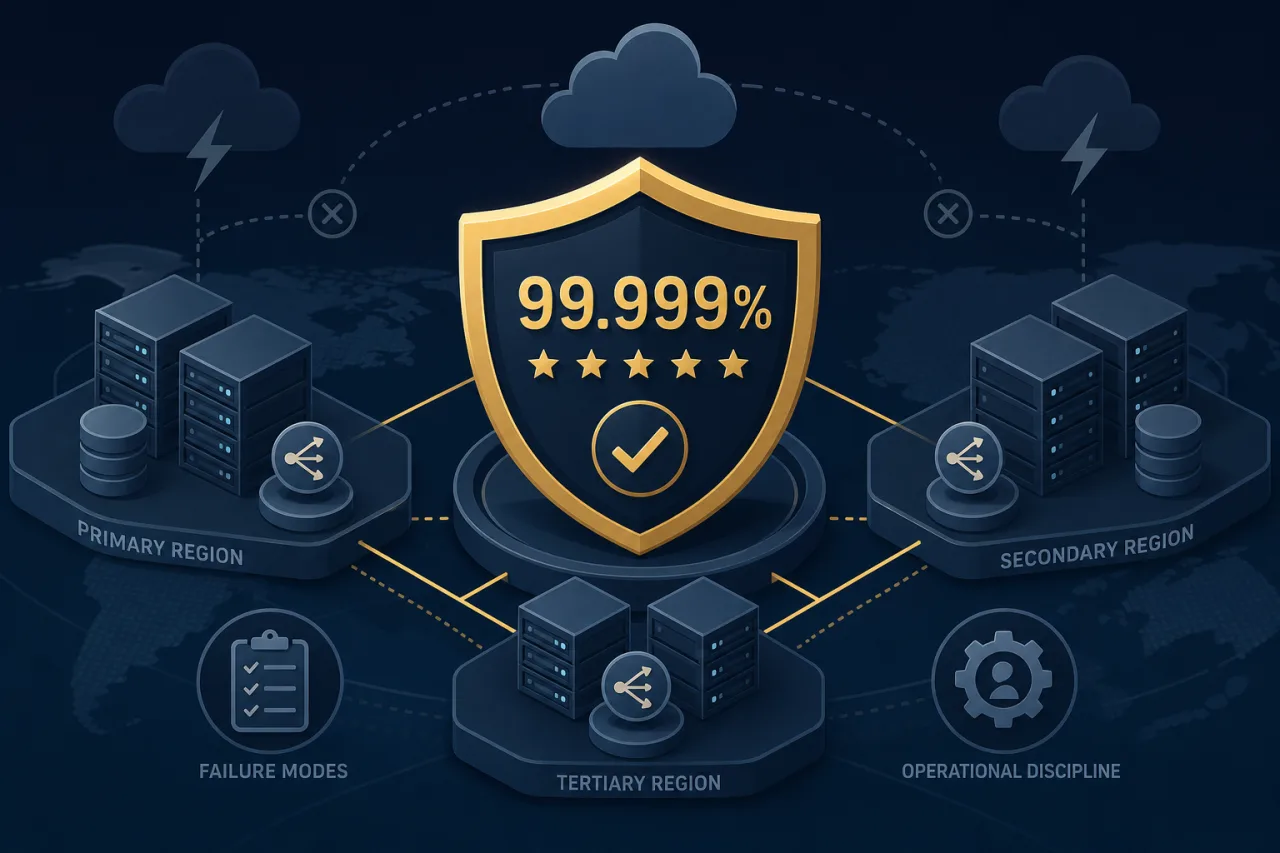
What Five-Nines Actually Means
Nine-nines uptime sounds like marketing until you do the math. 99.999% availability allows roughly 5 minutes and 15 seconds of downtime per year. That's not a maintenance window — that's barely enough time to page someone and pull up a runbook.
For most teams, the gap between 99.9% (8.7 hours/year) and 99.999% is not a matter of trying harder. It requires fundamentally different architecture.
Eliminate Single Points of Failure First
Every component that can take your service down on its own is a SPOF. Before optimizing anything else, map your dependency graph and ask: what happens if this one thing fails?
Common SPOFs engineers underestimate:
- A single database primary with no automated failover
- A load balancer not deployed in an active-active pair
- DNS hosted with a single provider and no secondary
- TLS certificates managed manually without auto-renewal
- A third-party API your service calls synchronously on every request
The fix is redundancy — but redundancy only helps if it's active and tested. A standby replica that has never been promoted is a liability, not an asset.
Design for Independent Failure Domains
Redundancy within a single availability zone is not enough. A power event, network partition, or misconfigured maintenance script can take down an entire zone at once.
Multi-AZ as a baseline
Deploy across at least two availability zones within your primary region. Use your cloud provider's AZ-aware load balancing so traffic is automatically rerouted when one zone degrades.
Multi-region for the highest tiers
For true five-nines targets, plan for regional failures too. This means:
- Active-active or active-passive deployments across two or more geographic regions
- Global load balancing (Cloudflare, AWS Global Accelerator, or equivalent) that can shift traffic in seconds
- Data replication strategies that tolerate a region going dark — with clearly defined RPO and RTO targets
- Regular failover drills, not just table-top exercises
Multi-region adds real complexity in data consistency. Choose your trade-offs deliberately: eventual consistency is often acceptable for reads; writes usually need more careful handling.
Make Deployments Non-Events
Deployments are one of the most common sources of unplanned downtime. At five-nines, you cannot afford a deployment that takes the service down for even 90 seconds.
- Use blue-green deployments or canary releases — never deploy directly to 100% of traffic
- Implement automated rollback triggered by error rate or latency thresholds, not human judgment
- Keep deployment artifacts immutable; don't mutate running containers in place
- Apply database migrations backward-compatibly so you can roll back the application without rolling back the schema
Build Graceful Degradation Into the Application Layer
When dependencies fail — and they will — your service should degrade gracefully rather than failing completely.
Practical patterns:
- Circuit breakers: stop hammering a failing downstream service and return a cached or default response instead
- Bulkheads: isolate thread pools or connection pools so one slow dependency can't exhaust resources for unrelated features
- Timeouts everywhere: never let a network call block indefinitely; set aggressive timeouts and handle the error explicitly
- Feature flags: toggle off non-critical features under load or partial outage without a full redeploy
Instrument Everything and Alert on Symptoms
You cannot defend an SLA you cannot measure. Five-nines demands observability at every layer.
What to measure
- Availability and error rate per endpoint, not just aggregate uptime
- P95 and P99 latency — slow responses often precede outages
- Dependency health: database connections, queue depth, external API error rates
- Synthetic transactions that verify real user paths end-to-end
External monitoring matters
Internal health checks have a blind spot: they can't detect problems that affect users but not your internal network — DNS failures, BGP route leaks, or CDN edge issues. Running checks from multiple external locations (as multi-region monitoring services do) gives you ground truth closer to what your users actually experience.
Set alerts on symptoms (elevated error rate, latency spike) rather than just causes. You want to know your users are affected before you've diagnosed why.
Operate with Rigor
Architecture gets you most of the way. The rest is process:
- Maintain and regularly test runbooks for every known failure mode
- Run chaos engineering exercises in production or a production-like environment
- Review every incident with a blameless postmortem and track action items to completion
- Keep your on-call rotation staffed and escalation paths clear
Key Takeaways
- 99.999% uptime allows ~5 minutes of downtime per year — the math forces architectural change, not just operational care
- Eliminate SPOFs systematically; redundancy only counts if it's actively used and regularly tested
- Deploy across multiple AZs at minimum; multi-region is necessary for the highest availability tiers
- Make deployments safe with blue-green or canary strategies and automated rollback
- Instrument symptoms, not just causes, and validate your monitoring from outside your own network
- Operational discipline — tested runbooks, chaos drills, blameless postmortems — closes the gap that architecture alone can't