
What a CDN Actually Does
A CDN is a geographically distributed network of servers—called edge nodes or PoPs (Points of Presence)—that cache and serve content closer to end users. Instead of every request traveling to your origin server, the edge node nearest to the visitor handles it.
This has two direct reliability benefits:
- Reduced origin load — cached responses never touch your servers.
- Shorter blast radius — a regional network problem affects fewer users when traffic is spread across dozens of locations.
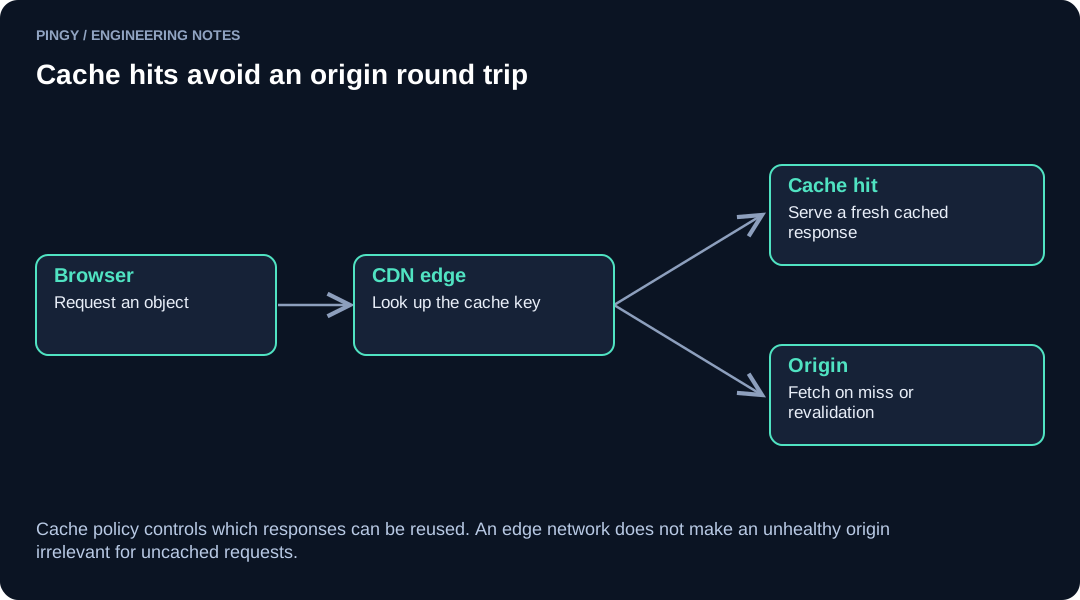
How CDNs Absorb Traffic Spikes
Cache Hit Rate Is Everything
When a CDN edge serves a cached response, your origin sees zero load for that request. If a blog post gets picked up by a large aggregator and suddenly receives 50,000 requests in ten minutes, a CDN with a high cache hit rate will absorb most of that without your application server noticing.
The key levers that control this:
- TTL (Time to Live) — how long the edge caches a response before revalidating with origin.
- Cache-Control headers — you control cacheability at the response level (
public,max-age,s-maxage). - Cache key design — avoid cache-busting on irrelevant query parameters (many CDNs let you normalize or ignore them).
Request Coalescing
When a cached object expires and many requests arrive simultaneously, a naive setup would forward all of them to origin at once—called a thundering herd. Most CDNs handle this with request coalescing (also called request collapsing): only one request goes to origin while the rest wait for that single response to fill the cache. Confirm your CDN supports this; Cloudflare, Fastly, and AWS CloudFront all do.
Rate Limiting and DDoS Mitigation at the Edge
CDNs sit in front of your infrastructure, which makes them a natural place to absorb volumetric attacks and enforce rate limits before malicious or runaway traffic reaches your origin. This isn't a replacement for application-level controls, but it meaningfully reduces exposure.
How CDNs Improve Uptime
Origin Failover and Health Checks
Enterprise-tier CDNs (Fastly, Cloudflare, Akamai) support origin shielding and failover origins. If your primary origin fails a health check, the CDN can route to a secondary origin or, for cacheable content, continue serving stale responses for a configurable grace period. This is sometimes called stale-while-revalidate or serve-stale-on-error.
To configure this properly in Cloudflare Workers or Fastly VCL:
- Define a primary and secondary backend.
- Set health check thresholds (e.g., 3 failures in 10 seconds).
- Configure
stale-if-errorin your Cache-Control headers so the edge can serve stale content during origin outages. - Test failover in staging before relying on it in production.
Anycast Routing
CDNs that use anycast networking advertise the same IP address from multiple locations. DNS resolves to the same IP, but BGP routing delivers the request to the nearest healthy PoP. This means regional network outages are automatically routed around—users in another region don't notice.
TLS Termination at the Edge
TLS handshakes are expensive and latency-sensitive. Terminating TLS at the edge reduces handshake round-trip time for users and offloads CPU from your origin. Fewer stalled connections means better availability under load.
What CDNs Don't Fix
Be clear-eyed about the limits:
- Dynamic, uncacheable content (API responses with auth, personalized pages) still hits origin every time.
- Origin bugs and database failures are invisible to the CDN if you don't configure stale-on-error.
- Misconfigured cache headers can accidentally cache private data or produce stale bugs that are hard to diagnose.
- A CDN is not a substitute for horizontal scaling of your origin tier.
Where Uptime Monitoring Fits In
A CDN can mask origin problems from end users—which is great for availability but dangerous for observability. If your CDN is happily serving stale cached content while your origin is down, your users won't see errors, but your application is still broken.
This is where monitoring from multiple external regions matters. A tool like Pingy running checks from several geographic locations can tell you whether your origin is actually responding, independent of what the CDN is caching. Set up both an edge-level check (your CDN URL) and a direct origin check (bypass the CDN using a secret header or IP allowlist) so you see both layers.
Key Takeaways
- High cache hit rates are the primary mechanism by which CDNs absorb traffic spikes—invest time in your caching strategy.
- Request coalescing prevents thundering herd problems at cache expiry; verify your CDN enables it.
- Configure origin failover and
stale-if-errorso the CDN can maintain availability during partial origin outages. - Anycast routing provides automatic regional failover without DNS TTL delays.
- CDNs improve perceived uptime but can hide real origin failures—monitor both your CDN edge and your origin directly.