What a CDN Actually Does
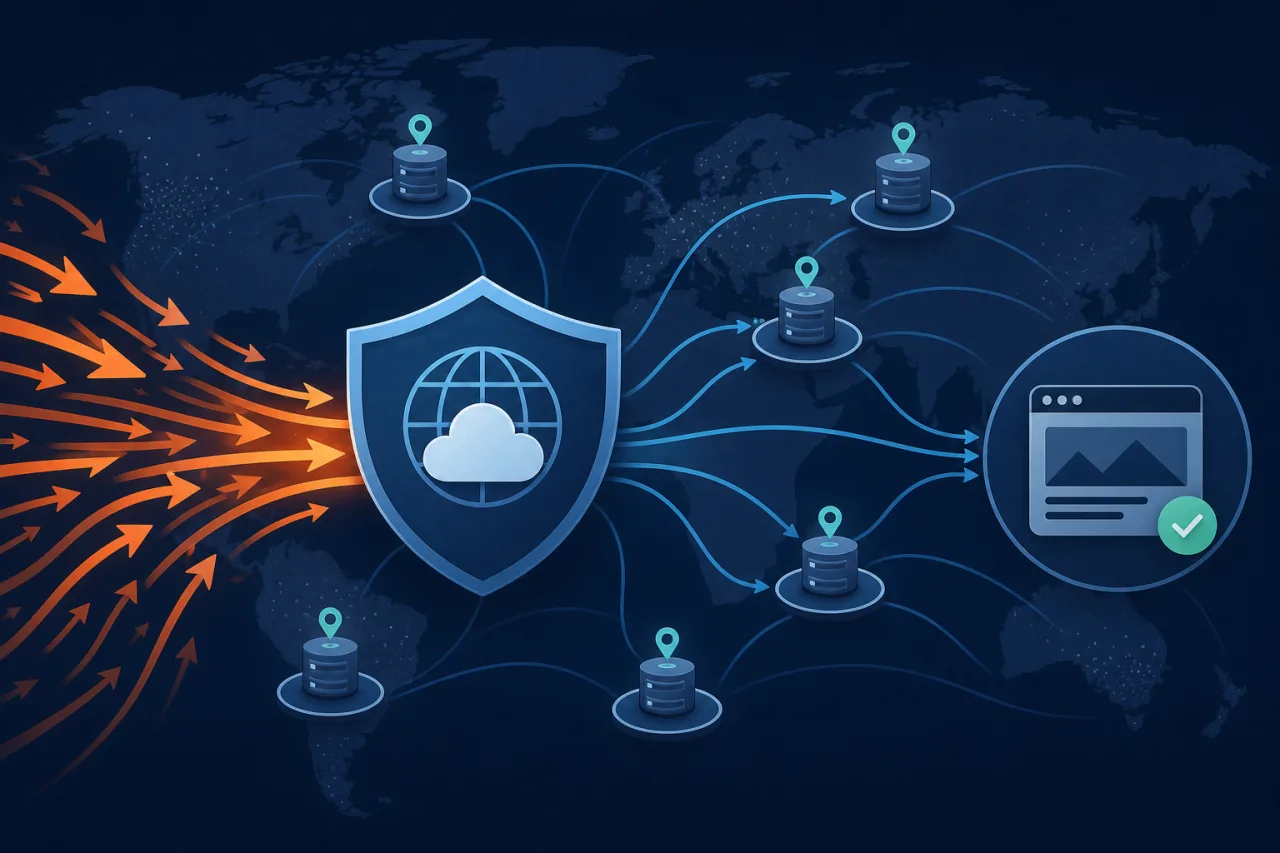
A CDN (content delivery network) is a geographically distributed set of servers — called edge nodes or PoPs (points of presence) — that cache and serve your content closer to end users. When a request comes in, it hits the nearest edge node rather than your origin server.
This matters for uptime in two concrete ways:
- Reduced origin load — Static assets, cached API responses, and full-page caches served from the edge never reach your origin. Fewer requests to your origin means less chance it gets overwhelmed.
- Fault isolation — If your origin goes down momentarily, a CDN serving stale cache can keep the site available to users while you recover.
How CDNs Absorb Traffic Spikes
When you get a sudden surge — a product launch, a Reddit mention, a breaking-news link — the traffic doesn't arrive at your origin as a wall. It fans out across dozens or hundreds of edge nodes, each serving cached responses locally.
This works well for:
- High-cache-hit workloads — Static sites, media files, JS/CSS bundles, and pages with long TTLs benefit most.
- Thundering-herd protection — A CDN can collapse simultaneous cache-miss requests for the same object into a single upstream fetch (request coalescing), protecting your origin from redundant load.
- DDoS absorption — Large CDNs have network capacity measured in terabits per second, far exceeding what any single origin can handle.
For dynamic or personalized content, benefits are smaller — but techniques like edge-side includes (ESI), short TTLs on partial caches, or Stale-While-Revalidate headers still help.
Common CDN Failure Modes
CDNs improve uptime on average, but they introduce their own failure surface. Treat a CDN as infrastructure, not insurance.
Misconfigured cache rules
If your CDN caches a 500 error response (it can, if your Cache-Control headers aren't set defensively), that error gets served to every user until the TTL expires. Always set Cache-Control: no-store or short TTLs on error responses.
Origin shield misconfiguration
Many CDNs offer an "origin shield" — a single intermediate node that fetches from your origin on behalf of all edge nodes. If the shield region goes down and you haven't configured a fallback, edge nodes fail to revalidate and may serve stale or error pages.
CDN provider outages
CDN providers have outages. When a major CDN goes down, it can take large swaths of the internet with it. Options:
- Use a multi-CDN setup with DNS-based failover
- Keep your origin reachable directly as a last resort
- Monitor your site's availability from multiple regions so you catch a CDN failure fast
This is where external uptime monitoring earns its keep. If you only monitor from one location, a regional CDN failure might look like normal traffic to your internal tools but be a full outage for users in that geography. Multi-region monitoring (like what Pingy runs) lets you distinguish "my origin is down" from "one CDN PoP is misbehaving."
Setting Up a CDN for Resilience: A Checklist
- Set explicit
Cache-Controlheaders on all responses — don't rely on CDN defaults. - Configure custom error pages at the CDN layer so users see something useful during origin failures.
- Enable stale-while-revalidate for high-traffic cacheable content so edge nodes don't stampede your origin on TTL expiry.
- Set up health checks from CDN to origin — most CDNs support this and will stop routing traffic to a sick origin automatically.
- Test your failover path — pull your CDN out of the equation and confirm your origin handles direct traffic, even if degraded.
- Monitor from the outside — verify that what users see at the edge matches what your origin reports. Cache bugs and CDN-level errors won't show in application logs.
What CDNs Won't Fix
A CDN won't save you if:
- Your database is the bottleneck — edge caching doesn't help un-cached dynamic queries
- Your origin is misconfigured — a CDN faithfully forwards broken responses
- Your DNS is the problem — if your DNS provider is down, users may never reach the CDN in the first place
Layer your resilience: CDN + solid origin architecture + redundant DNS + external monitoring.
Key Takeaways
- CDNs reduce origin load and can serve stale content during short outages, improving effective uptime.
- Traffic spikes are absorbed through geographic distribution and request coalescing — most effective for cacheable content.
- CDNs introduce their own failure modes: cache poisoning, shield misconfiguration, and provider outages.
- Monitor your site from multiple external regions to distinguish CDN-layer failures from origin failures.
- A CDN is one resilience layer, not a substitute for a stable origin, good DNS, or external monitoring.