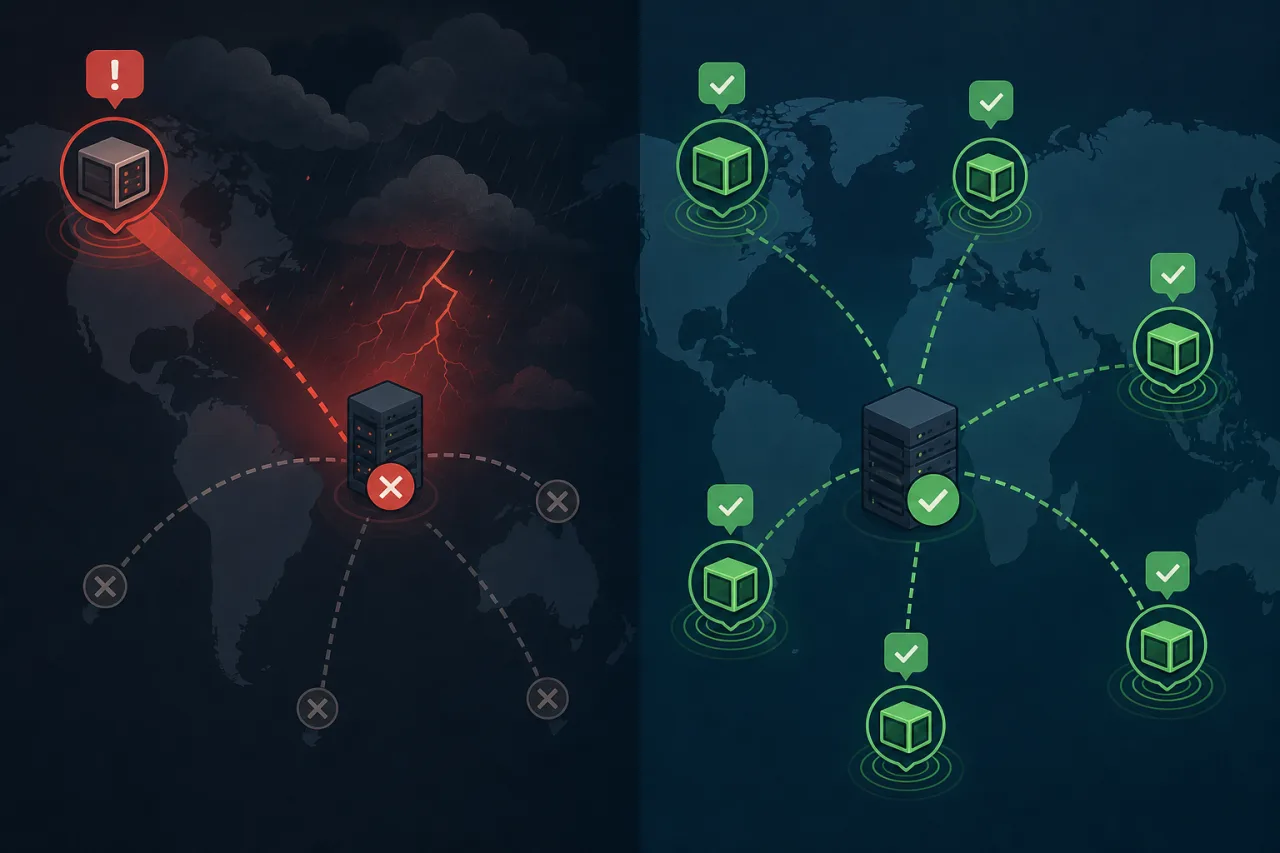
The Problem With Checking From One Place
A uptime monitor with a single vantage point is essentially asking one person to watch the entire internet. If that monitor lives in us-east-1 and your users are in Frankfurt, Tokyo, and São Paulo, you're not measuring their experience — you're measuring one narrow slice of it.
Worse, single-location checks introduce two failure modes that erode trust in your alerting:
- False positives — the monitoring node has a blip (network congestion, a BGP hiccup, a momentary DNS resolution failure) and pages your on-call engineer at 3 AM for a problem that never existed for real users.
- False negatives — your CDN or load balancer fails in one region, thousands of users get errors, but the single check node happens to be in the one region that's still healthy.
Both failures are expensive. False positives cause alert fatigue. False negatives mean real outages go undetected.
What Multi-Region Monitoring Actually Gives You
Confirmation Before Alerting
When a check fails from one location, a multi-region monitor can immediately re-verify from two or three others before firing an alert. If only one region sees a failure, that's a strong signal it's a network issue local to that probe — not a global outage. If three regions see it simultaneously, you have high confidence the site is actually down.
This pattern — requiring agreement from multiple independent vantage points — is the same logic behind quorum systems in distributed databases. It reduces noise dramatically.
Detecting Regional and CDN Failures
Modern infrastructure is distributed. Your app likely runs behind a CDN, a global load balancer, or multi-region deployments. A failure in one edge location might serve errors to users in Europe while users in North America are completely unaffected.
A single-region monitor will miss this entirely unless it happens to be in the affected region. Multi-region monitoring makes these partial outages visible — and that matters, because a partial outage affecting 30% of your users is still an incident worth responding to.
Latency Visibility Across Geographies
Checks from multiple locations also give you response-time data per region. You might discover that your application responds in 180 ms from Virginia but 2,400 ms from Sydney — not because it's down, but because you haven't deployed a regional instance or CDN presence there. That's actionable performance data you'd never see from a single probe.
Common Objections (and Why They Don't Hold Up)
"We only have users in one country." Your DNS, CDN, and cloud provider do not operate within one country. A routing issue affecting a backbone between two US cities can still be caught earlier if you monitor from both coasts rather than a single data center.
"It'll generate too many alerts." The opposite is true when implemented correctly. Requiring consensus across probes before alerting reduces false-positive pages.
"We'll set up multi-region monitoring once we scale." Incidents don't wait for you to scale. The cost of setting up distributed checks is low; the cost of a missed regional outage is not.
How to Implement Multi-Region Checks Effectively
- Choose probe locations that match your user geography. If your users are in the US, EU, and Southeast Asia, your monitors should be too. Don't just pick whatever your monitoring tool defaults to.
- Require 2-of-N confirmation before alerting. Most monitoring tools support a consensus or re-verification step. Use it.
- Set separate latency thresholds per region if needed. A 500 ms response time might be acceptable from a far-away region but a red flag from a nearby one.
- Monitor from outside your own infrastructure. Probes that run inside your own cloud account share blast radius with your app. Use a third-party service with independent infrastructure.
- Review regional check history after incidents. Post-mortems often reveal that one region started failing minutes before global impact — that's early warning signal you can tune on.
- Don't forget non-HTTP checks. TCP, DNS, and TLS certificate checks also benefit from multi-region confirmation. A DNS failure that only one resolver sees is likely a resolver problem, not yours.
Services like Pingy run checks from multiple geographies and require confirmation before alerting, which handles steps 2 and 4 automatically — useful if you don't want to build and maintain the probe infrastructure yourself.
Key Takeaways
- A single-location monitor cannot distinguish between a local network blip and a real outage.
- Multi-region checks reduce both false positives (alert fatigue) and false negatives (missed regional failures).
- Requiring consensus from multiple probes before alerting is the single highest-leverage improvement you can make to your monitoring setup.
- Partial outages — one region or CDN edge failing — are invisible to single-node monitoring.
- Multi-region latency data doubles as free performance diagnostics across geographies.
- Set this up now, regardless of your current scale. Outages don't schedule themselves around your growth plans.