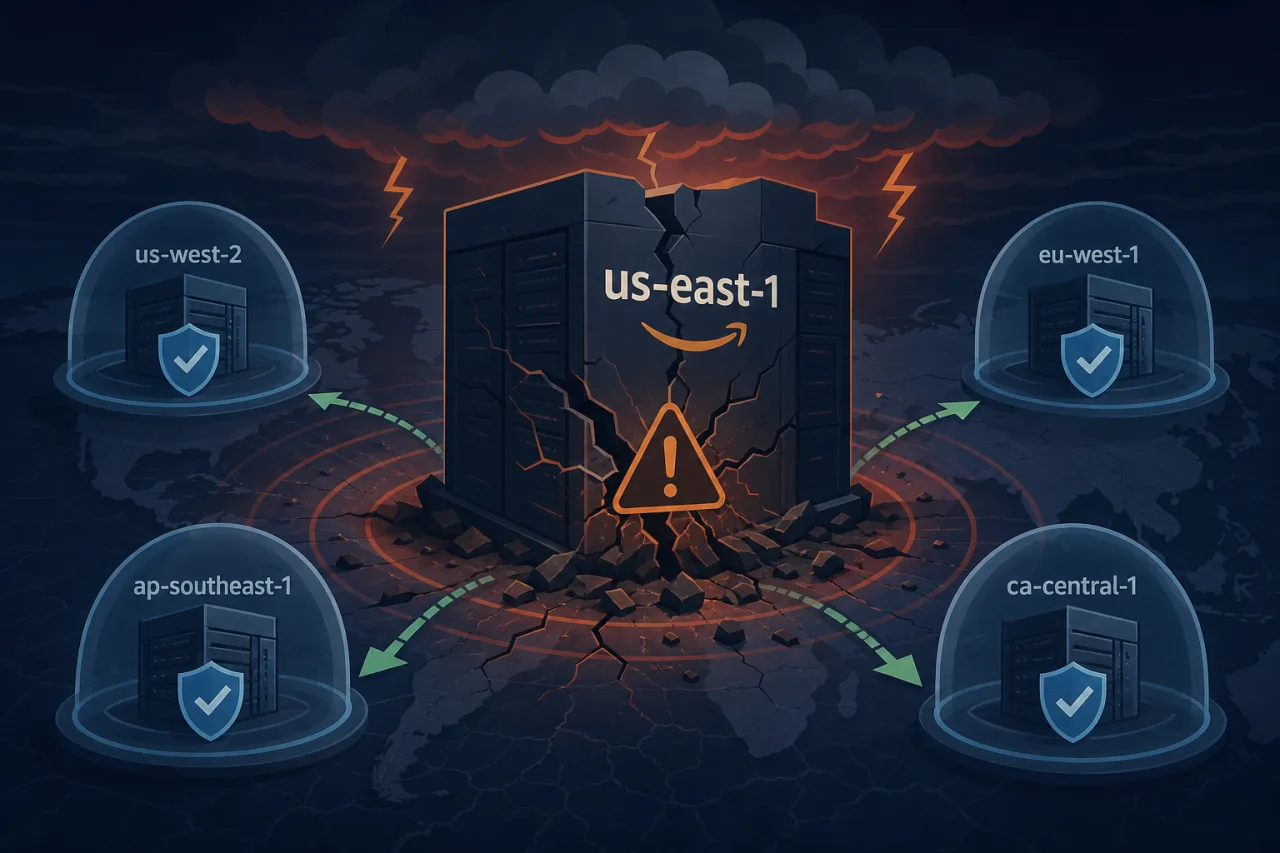
The Elephant in the Room
us-east-1 (Northern Virginia) is AWS's original region, its largest, and the one where AWS itself runs a significant chunk of its own control-plane infrastructure. That combination makes it uniquely fragile compared to every other region.
This isn't speculation. The AWS Service Health Dashboard has a long public record of us-east-1 outages affecting EC2, S3, Lambda, IAM, and Route 53 — sometimes simultaneously. When IAM goes down in us-east-1, it can break authentication across accounts that don't even have workloads there, because IAM's global endpoints are served out of that region.
Why us-east-1 Is Different
It carries the most traffic
More AWS customers default to us-east-1 than any other region. That density means more noisy neighbors, more pressure on shared infrastructure, and a higher blast radius when something in the underlying physical or network layer goes wrong.
AWS's own services live there
Many AWS global services — IAM, CloudFront's control plane, Route 53 health checks, the AWS Management Console — have a heavy dependency on us-east-1. An outage there can cascade into services that look, on paper, like they're global or replicated.
It's the oldest infrastructure
us-east-1 has been running since 2006. That means layers of legacy hardware, network topology, and software stacks exist alongside modern infrastructure. AWS continuously upgrades, but the operational complexity of a region this size and age is unavoidable.
New features land here first
AWS typically launches new instance types, services, and capabilities in us-east-1 before anywhere else. Early-availability code is, by definition, less battle-tested.
What an Outage Actually Looks Like
A us-east-1 failure rarely takes down everything at once. More often you see:
- EC2 API calls timing out while existing instances keep running
- Auto Scaling groups unable to launch new instances
- S3 PutObject failing while GetObject continues working
- Lambda cold starts failing or spiking to multi-second latency
- CloudWatch metrics and alarms going stale, making diagnosis harder
The insidious part is that partial failures are harder to detect than total outages. Your health checks might pass because existing connections are alive, while your ability to recover from any failure is silently gone.
How to Reduce Your Blast Radius
1. Stop treating us-east-1 as your only region
If your entire stack lives in us-east-1, you have a single point of failure you can't control. Even adding a warm standby in us-west-2 or eu-west-1 gives you somewhere to fail over to.
2. Use Route 53 latency or failover routing
Route 53 health checks combined with failover routing records let you shift traffic to a secondary region automatically. Test this regularly — a failover policy you've never exercised is not a real failover policy.
3. Design for regional independence
Avoid cross-region dependencies in your hot path. If your us-east-1 app calls an API that only exists in us-east-1, you haven't gained anything by adding a second region.
4. Pre-provision capacity in your secondary region
Launching new EC2 instances during an AWS capacity event is exactly when you're least likely to succeed. Keep a minimum footprint running in your standby region so you're not racing to provision during an incident.
5. Monitor from outside your own infrastructure
If your monitoring runs in us-east-1 and us-east-1 is having a bad day, your monitors may be the first thing to go dark. External uptime monitoring from multiple geographic vantage points — probing your endpoints from regions and networks outside AWS us-east-1 — gives you a signal you can trust even when your internal observability stack is compromised. This is where multi-region monitoring services are genuinely useful: Pingy, for example, checks from multiple locations so a single-region AWS event doesn't blind your alerting.
6. Build a runbook before you need it
Write down the exact steps to fail over: who does what, in what order, using what credentials (stored outside us-east-1). Practice it on a quiet Tuesday, not during a 2am incident.
A Quick Pre-Outage Checklist
- Secondary region is configured and has been tested for failover
- DNS TTLs are low enough to make failover meaningful (60–120s)
- IAM credentials and secrets are accessible outside us-east-1
- External monitoring is probing production endpoints, not internal health routes
- Runbook is written, versioned, and accessible outside AWS (e.g., in a Git repo or a doc your team can reach from a phone)
- RDS or data layer has a cross-region read replica or backup restore procedure documented
- Auto Scaling AMIs exist in secondary regions
Key Takeaways
- us-east-1 fails more than other regions because of its size, age, density, and role in AWS's own global control plane.
- Partial failures are common and harder to detect than full outages.
- A real multi-region strategy requires pre-provisioned capacity, independent hot paths, and tested failover procedures.
- Your monitoring must be external to the infrastructure it's watching — otherwise the outage takes out your visibility at the same time it takes out your service.
- Runbooks only work if they're written, tested, and reachable during the outage itself.