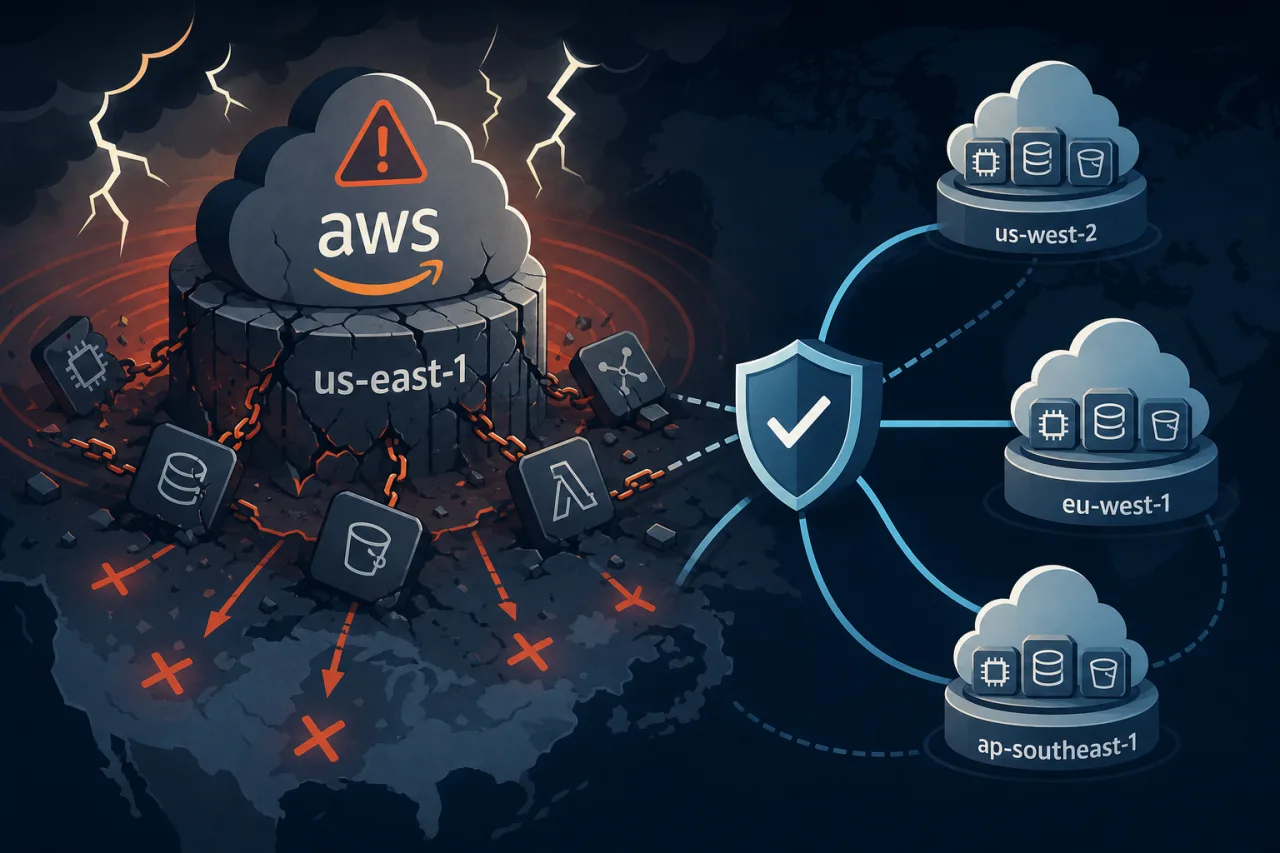
The Oldest Region Carries the Most Baggage
us-east-1 (Northern Virginia) was AWS's first region, launched in 2006. It hosts more AWS services, more shared infrastructure, and more customer workloads than any other region on the planet. That scale is also its Achilles heel.
When something goes wrong in us-east-1 — a bad network change, a capacity issue, a dependency failure — it tends to go wrong loudly and broadly. The December 2021 outage knocked out not just EC2 and RDS workloads but also the AWS console itself, making it harder for teams to diagnose or respond. The November 2020 Kinesis incident cascaded into Cognito, Lambda, and CloudWatch because so many services depend on Kinesis for internal telemetry.
None of this means us-east-1 is poorly run. It means large, dense infrastructure with deep service interdependencies has a larger blast radius when anything goes wrong.
Why Teams Default to us-east-1 Anyway
- Service availability: New AWS services almost always land in us-east-1 first, sometimes months before other regions.
- Latency to US East Coast users: For a large portion of North American traffic, it's the closest option.
- Legacy defaults: Many AWS CLI defaults, Terraform modules, and internal runbooks were written assuming us-east-1.
- Cost: Some instance types and reserved capacity are cheapest or most available there.
These are real reasons, not just inertia. But they don't justify betting your entire production stack on a single region.
The Architectural Moves That Actually Help
1. Active-Active Multi-Region (When You Can Afford It)
Running the same workload in two or more regions simultaneously gives you instant failover without a recovery step. Route 53 latency-based or health-check routing can shift traffic in under a minute. The cost and operational complexity are real — you need globally consistent data, which usually means DynamoDB Global Tables, Aurora Global Database, or a CockroachDB-style distributed SQL layer.
This is the right answer for high-availability APIs, authentication services, and anything customer-facing.
2. Active-Passive with Tested Failover
If active-active is too expensive, run a warm standby in a second region — us-west-2 is a common choice — with data replication in place and a runbook that your team has actually executed in a drill. An untested failover plan is not a failover plan.
Key checklist for your warm standby:
- RDS read replica promoted to primary in the failover region
- DNS TTLs set low (60 seconds or less) before any planned maintenance window
- IAM roles and secrets replicated to the failover region
- CDN origin failover configured (CloudFront supports origin groups)
- Application configuration (SSM parameters, Secrets Manager) mirrored
- Runbook last tested within the past 90 days
3. Reduce Your Dependency on Global AWS Services
Some AWS services are global and route through us-east-1 regardless of where your workload runs. IAM, Route 53, and the AWS Management Console are the main ones. During the 2021 outage, teams couldn't use the console to remediate because it depended on services that were degraded.
Practical mitigations:
- Pre-generate IAM credentials and store them in your secrets manager so automation doesn't depend on IAM API calls during an incident.
- Use break-glass runbooks that rely on AWS CLI with cached credentials rather than the console.
- Avoid architectures where Route 53 health checks are the only signal driving failover — pair them with application-level checks.
4. Monitor from Outside Your Blast Radius
This one is straightforward but frequently skipped. If your monitoring infrastructure lives in us-east-1 and us-east-1 is having a bad day, your monitors may not fire — or may fire inconsistently. Running uptime checks from multiple external regions (us-west-2, eu-west-1, ap-southeast-1, etc.) gives you a signal that's independent of the region under stress.
This is exactly the problem multi-region monitoring tools like Pingy are designed for: checks run from geographically distributed probe locations, so a regional AWS event doesn't silence your alerting at the same time it's hurting your users.
5. Use AWS AZ-Level Isolation Where Possible
Not every failure is region-wide. Many us-east-1 incidents have been isolated to one or two Availability Zones. Spreading your Auto Scaling groups, RDS Multi-AZ deployments, and EKS node groups across all available AZs in the region costs almost nothing and protects against a significant class of partial failures.
Key Takeaways
- us-east-1 fails more visibly because it's the largest, most interconnected AWS region — not because it's less reliable per unit of infrastructure.
- Single-region deployments in us-east-1 give you the worst of both worlds: high dependency on a busy region with no escape hatch.
- Active-active multi-region is the gold standard; active-passive with a tested runbook is a reasonable middle ground.
- Global AWS services (IAM, the console) can be part of your blast radius even if your compute is elsewhere — design for that.
- Your monitoring should never live only inside the region it's monitoring.