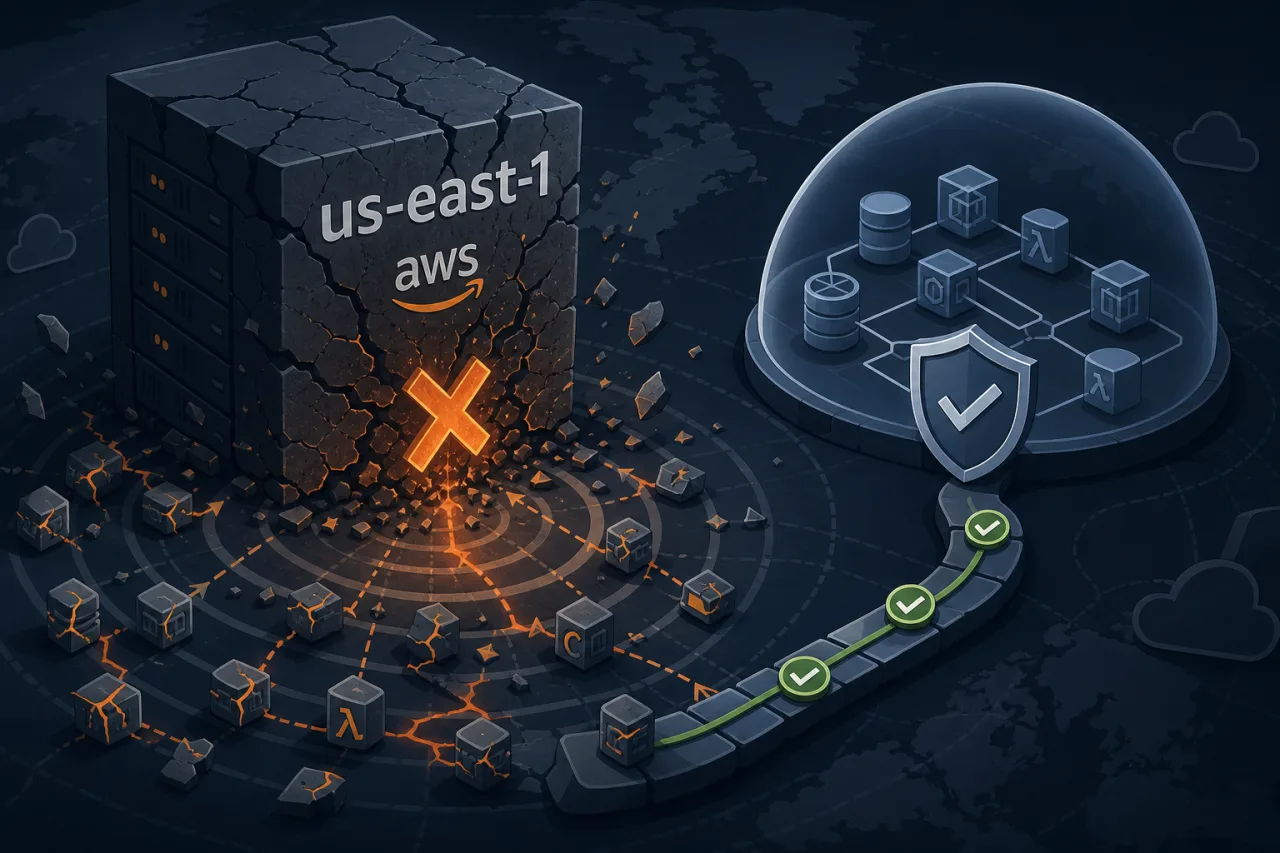
A regional outage can stop an application even when its servers are spread across several Availability Zones. Multi-AZ design addresses failures within a Region. Recovery from a regional disruption needs a separate plan.
It is tempting to rank AWS Regions by the number of incidents in public reports. Those counts do not provide a comparable failure rate: workloads, services, exposure and reporting differ. This guide does not claim that us-east-1 is inherently less reliable than another Region. The practical question is which failures your application can tolerate and which dependencies its recovery path still needs.
Draw the complete request path
Start with a user action that matters, such as signing in or completing an order. Map DNS, the edge, load balancing, application capacity, data stores, identity, secrets and third-party APIs.
For each dependency, record its scope and failure behavior. Does an existing workload continue if its management API becomes unavailable? Does a new instance need that API during startup? Can a failover runbook fetch credentials without reaching the affected Region?
AWS distinguishes data-plane operations that serve an existing workload from control-plane operations that configure it. The exact boundary is service-specific. A recovery design that depends on creating infrastructure during the incident may have different risks from one with capacity already running.
Build a usable recovery environment
The diagram shows a primary Region and a prepared recovery stack. The second stack needs application code, configuration, access and usable data. Merely creating a second load balancer does not provide regional recovery.
Choose the data strategy around the recovery objectives. Replication lag determines which recent writes may be missing. A backup restore needs a measured restoration process. Replication can also copy accidental deletion or corruption, so keep recoverable history where the workload requires it.
Decide who can promote the recovery database and how the previous writer will be fenced off. Sending writes to two independently promoted databases without a conflict strategy can create a worse incident than a longer controlled outage.
Plan the traffic change
DNS failover can direct future answers to a recovery endpoint. Existing caches and connections may continue using the old destination. A shorter TTL does not make the switch instantaneous or remove the need for client retries.
Before routing traffic, verify the recovery endpoint independently. Confirm TLS, authentication, reads, writes and any externally visible side effects. Ensure that the recovery environment can handle the expected load, including retries and queued work.
Write down the reversal procedure too. Returning to the original Region requires deciding which data copy is authoritative and reconciling changes made during recovery.
Keep recovery access available
Store the runbook where responders can reach it during the incident. Test emergency access and account recovery procedures. Check whether deployment artifacts, container images, DNS management, secret retrieval or communication tools introduce a dependency on the failed environment.
This does not require making every dependency multi-region. It requires identifying the dependencies you accept and proving that the intended recovery path works under those assumptions.
Rehearse and record the result
Use a test environment first. Define the fault to simulate, the person coordinating the exercise, and conditions that stop it. Measure from the declared disruption to a validated user journey, and measure the recoverable data point separately.
Record any manual steps or unexpected dependencies. Turn them into changes with owners and repeat the exercise after fixing them. A successful infrastructure deployment is not the same as a successful application recovery.
External checks from separate networks help confirm the public endpoint before and after the switch. They complement application-level validation. Keep monitoring and incident communication available outside the failure domain you are testing.