What AWS Regions and Availability Zones Actually Are
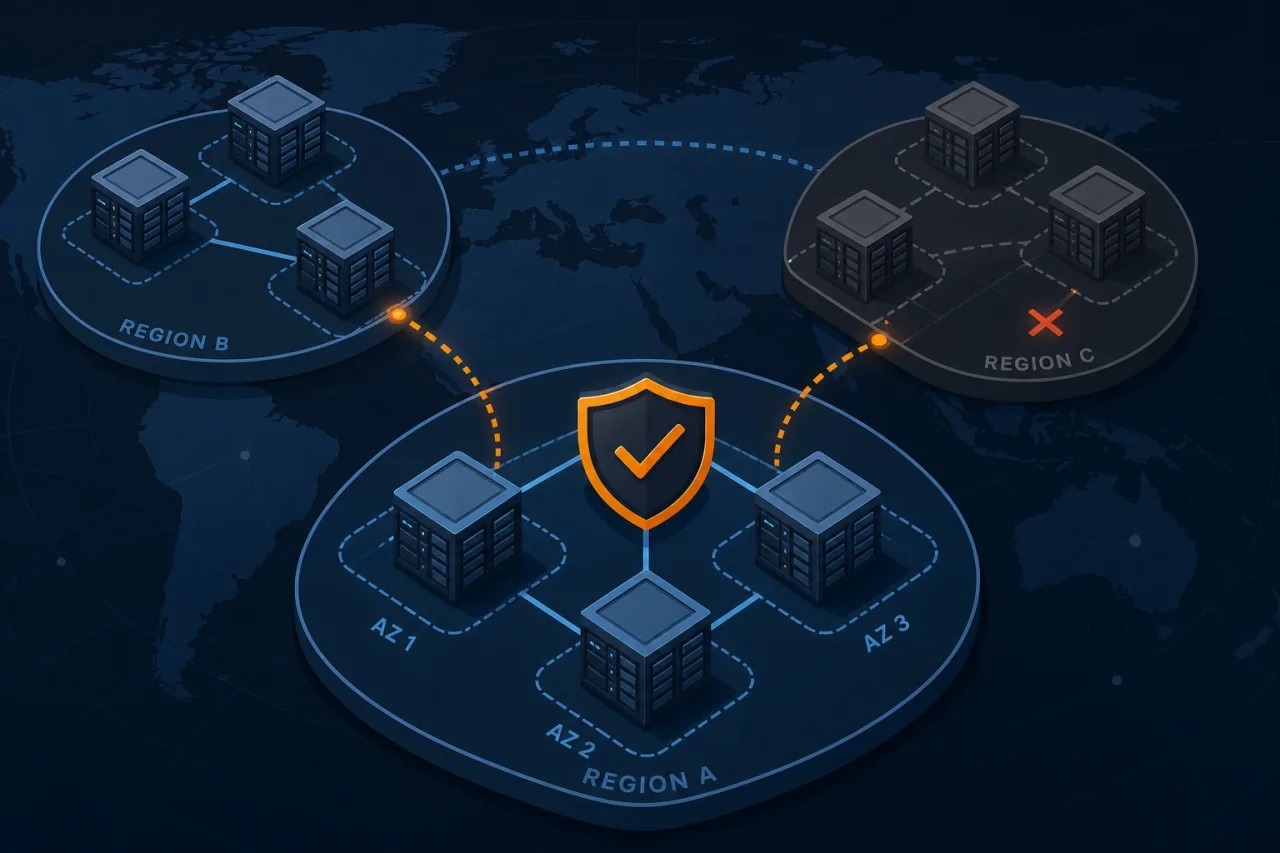
An AWS Region is a distinct geographic area — us-east-1 (N. Virginia), eu-west-1 (Ireland), ap-southeast-1 (Singapore), and so on. Each Region operates independently, with its own power, networking, and control plane.
Within each Region, AWS carves out Availability Zones (AZs) — physically separate data centers (or clusters of them) connected by low-latency, high-bandwidth private fiber. us-east-1 has six AZs: us-east-1a through us-east-1f. They share the same regional control plane but fail independently.
The practical upshot:
- An AZ outage (hardware failure, power event) should not affect other AZs in the same Region.
- A Region outage (rare, but it happens) affects everything in that Region regardless of how many AZs you use.
Multi-AZ: The Baseline
If you're running anything production-grade, you should be spanning at least two AZs. This is table stakes, not a premium feature.
What to spread across AZs
- EC2 instances — use Auto Scaling Groups with a balanced AZ distribution policy.
- RDS — enable Multi-AZ deployments; AWS handles synchronous replication and automatic failover.
- ElastiCache — use cluster mode or Multi-AZ replication groups depending on your engine.
- Application Load Balancers — automatically distribute traffic across AZs when configured with subnets in each.
- EKS node groups — define subnets in multiple AZs so the scheduler can place pods across them.
Common mistake: AZ-pinned EBS volumes
EBS volumes live in a single AZ. If your instance and its volume are in us-east-1a and that AZ has an event, you're stuck. Mitigate this with:
- Regular EBS snapshots (stored in S3, which is regional).
- Using EFS or S3 for data that needs to survive an AZ loss without manual intervention.
- Designing stateless application tiers so instances can be replaced in a healthy AZ immediately.
Multi-Region: When You Need It
Multi-AZ protects you from most day-to-day failures. Multi-Region protects you from:
- Regional AWS incidents (the
us-east-1events of 2021 and 2023 are instructive here). - Compliance requirements that mandate data residency in specific geographies.
- Latency requirements for globally distributed users.
Multi-Region adds real complexity. Go there deliberately, not as a default.
Patterns that work
Active-passive (warm standby): Your primary Region handles all traffic. A secondary Region runs a scaled-down but functional copy. Data replicates asynchronously (DynamoDB Global Tables, Aurora Global Database). On failure, you promote the secondary and update DNS. Recovery time is minutes, not hours.
Active-active: Traffic runs in multiple Regions simultaneously, routed by latency or geography via Route 53. Writes need careful handling — use a globally consistent data store (DynamoDB Global Tables with conflict resolution) or shard writes by region. Complex, but achieves near-zero RTO.
Pilot light: Only the absolute minimum runs in the secondary Region (a replicated database, perhaps). Everything else is defined in IaC and deployed on demand. Cheapest option; slowest recovery.
Data replication considerations
- DynamoDB Global Tables handle multi-master replication with last-writer-wins conflict resolution.
- Aurora Global Database provides a primary Region with up to five read-only secondaries; promotion takes under a minute in most cases.
- S3 Cross-Region Replication (CRR) is asynchronous — factor replication lag into your RPO.
Monitoring Across Regions
Architecting across Regions doesn't help if you don't know when one fails. CloudWatch metrics and alarms are regional — an outage in us-east-1 can prevent CloudWatch in that Region from alerting you.
This is where external uptime monitoring earns its keep. A service like Pingy checks your endpoints from multiple geographic locations outside AWS, so you get an alert even when the Region itself is impaired. Pair regional CloudWatch alarms with external monitoring to cover both the inside view and the outside-in perspective your users actually experience.
Deployment Checklist
Before calling your architecture HA, verify:
- Compute spans at least two AZs in every Region you operate in.
- Databases have Multi-AZ or Global replication enabled.
- Load balancers have subnets registered in each target AZ.
- Stateful storage (EBS) has a snapshot or failover plan.
- DNS TTLs are low enough for failover to propagate in your RTO window.
- Route 53 health checks are configured to trigger failover automatically.
- Runbooks exist for promoting a standby Region — and you've tested them.
- External monitoring confirms reachability from outside AWS.
Key Takeaways
- AZs protect against localized failures; Regions protect against large-scale incidents.
- Multi-AZ is the baseline for any production workload — there's no good reason to skip it.
- Choose your multi-Region pattern (active-passive, active-active, pilot light) based on your actual RTO/RPO requirements, not anxiety.
- EBS is AZ-local; design around that constraint explicitly.
- CloudWatch is regional — complement it with external, multi-location monitoring so you catch regional impairments from the outside.